Oscar

  • Oscar 2007: Film Score nominees

    So in the midst of a rather odd day, I finally managed to find out what the Academy nominated today.  All I can say is whichever network fought to broadcast this year's ceremony is probably kicking itself today.  That said, it looks from the various slate of nominees in a variety of categories that there should at least be the potential for some history in the making.  Here are the score nominees:  Babel (Gustavo Santaolalla); The Good German (Thomas Newman); Notes on a Scandal (Philip Glass); Pan's Labyrinth (Javier Navarrete); and Queen (Alexandre Desplat).  Only Babel was nominated for a Golden Globe, while Desplat won for a completely different score.  And this is the first time in over a decade that I have not heard the scores to any of the films being nominated yet.  A problem which will soon be corrected.

    Thomas Newman receives his 8th nomination for a score that supposedly hearkens back to the "Golden Age."  Navarrete receives his first nomination for a score that has been receiving a lot of notice including a Goya nomination in his native Spain.  Desplat receives his first nomination for a score also nominated for a BAFTA and receiving acclaim by film critics.

    Only two of the nominees are Americans which may be a first.  Four of them were born after 1954.  The oldest, Philip Glass, is ironically known for being a part of Minimalism, itself derived in part from film music and pop music's focus on smaller motivic musical ideas.  Glass is only five years younger than the current reigning dean of film music, John Williams.

    On top of this, one of film music's greatest living composers, Ennio Morricone will receive a special award for his career.

    I am amazed, and slightly gratified, that the list did not include Dreamgirls, but at the same time, I wish that we could have had a category for comedy/musical score given the past year's plethora of animated films featuring good scores and comedies with good scoring as well.  This particular slate will be tough to call.  I would pull for Desplat or Newman, leaning towards Newman.  Any one of these is essentially an upset and none have real name recognition beyond the die hard fans. 


    For some reason the photo for The Good German did not show up so you'll just have to search for it from one of the above links.

    At some point between now and February, I'll hopefully have more on each fo these scores.
  • Oscar Announcements: 1957

    Tuesday we will hear the announcement of nominations for the 2007 Academy Awards.  It should be an interesting slate regardless of what makes the cut.  I thought it might be interesting to look back 50 years and see what 1956 film scores were announced for the 1957 Award ceremony.  Then there were two categories (this happens invariably with the other being musicals, or comedy scores). 

    It was an interesting slate of nominations.  The great Alfred Newman (of which current composers Randy Newman, David Newman, and Thomas Newman are related) was nominated for the drama Anastasia.  He had one an Oscar the year before for Love is a Many-Splendored ThingAnastasia has an awesome main theme and is an engaging score that is probably one of the composers great accomplishments.  He would win though for his work on the musical The King and I along with choral arranger Ken Darby.  The CD is still available but is technically out of print, though it shows up once in a while. 

    Hugo Friedhofer is not as well known, unfortunately, as a composer on his own merits.  He was one og the great Hollywood orchestrators and had some opportunities for projects on his own.  His war drama score for Between Heaven and Hell is a solid piece of dramatic underscoring perfectly matching the film.  It works fairly well on its own as a solid 1950s dramatic piece.

    Dimitri Tiomkin had been writing for a variety of films and was beginning to create an unique sound for westerns.  Giant's one trivia claim is that it turned out to be James Dean's final film, being released after his death in a car accident.  If you hear Tiomkin's music alongside the other two, you can see both common Hollywoood scoring approaches or techniques that are really a part of the period, but also you can also be amazed at the approach to thematic writing, development, and even orchestration.  Each of the composers nominated so far were at the top of their game.

    Also nominated that year was Alex North's score to The Rainmaker.  He had caused a bit of a stir five years earlier by using jazz as the musical style for the underscore to A Streetcar Named Desire.  Somewhat musically-type cast for similar scores in the early 1950s, this film comes in the middle of North's combining traditional 1950s Hollywood scoring with his jazz-influenced music.  This is a romantic comedy film with Hepburn and Hudson which I can't say much more about having not ever seen it or even had a chance to hear the score.

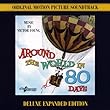
    The winner was the ever versatile Victor Young.  Many people will recognize Young's various songs which have entered the standard repertoire of many singers.  He had written hundreds of scores throughout a distinguished career that culminated in Around the World in 80 Days.  The score is finally being given a real release this year so it will be an awesome time to rediscover this music beyond it's delightful waltz.  He had been nominated many times for scores or songs over his career and had never won (he actually holds the record for the most nominations without a win).  Sadly, he would die of a stroke the previous November thus receiving the award posthumously.  With any luck we will have a chance to pick up a copy of this CD when it is released next week.

    The Winner:        

    The Nominees: