When you hear as much music as I get to on a regular basis, you have to hope to get some things that you can really just enjoy on their own. As a reviewer, there are generally three kinds of releases: great scores that basically have you trying to come up with new adjectives or descriptions that try to make sense of what you are hearing (for new styles or unknown composers especially), mediocre or middle-of-the-road works that are neither "great" or awful but will be enjoyable based on your own personal taste (or the weather, what you had for breakfast, etc.), and just horrible stuff that you want to be nice about. The latter things are actually the easiest to write about.
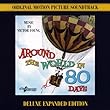
I've mentioned earlier hear the 1957 Oscar nominated scores. The winner then was Victor Young's Around the World in 80 Days. This epic Michael Todd film is among Hollywood's finest Golden Age extravaganzas and Young's score moves through a variety of world music as the balloonists travel around the world. There is a Spanish section, music using Hindu instruments, a fascinating Asian-influenced sequence with chanting in "Royal Barge of Siam," and stock "Indian" music in "Sioux Attack" (also using music from "William Tell"). But most importantly is one of Young's greatest screen waltz themes, "Around the World." This delightful melody is heard throughout the score and is orchestrated so wonderfully each time it appears. There is a lot to like about this score and it is the best way to spend 70+ minutes of your life. Young was a great melodist and many of his songs are still a part of the standard repertoire (at least of jazz musicians). This is one of those CDs every fan of film music should add to their collection. The original LP was even #1 for 10 weeks back in 1957.
Now jump ahead 50 years to Guillermo del Torro's fantasy film Pan's Labyrinth. The Academy-nominated score is by Spanish composer Javier Navarrete. This score is a lot more difficult but no less rewarding. It is held together by a thematic idea, "Mercedes Lullaby," that gets deconstructed along the way. The labyrinth itself is a musical character with its own track. It's shadow is cast upon all of the music and its impact twists and confuses the other thematic material it comes into contact with along the way changing them subtly. These two primary musical components make up the primary fabric of the score as it plays along. Navarrete is also equally adept at incorporating silences as part of his musical language in ways that allow on-screen action to insert themselves without damaging the organic way the music accompanies the images. Ultimately, one hears why this score has impressed itself among the film's supporters. It is among the composer's finest musical contributions that has much to recommend it. Having also been recorded in Prague, the overall orchestral sound has a completely different ambience than what Hollywood soundstages produce. Though this is really a typical sound for European film music recording. If you are a fan of Howard Shore's music you may find hints of a parallel style here. The Mercedes theme bears some resemblance to Morricone and there are even some wordless choral music one hears in Danny Elfman's music. But these are embedded into Navarrete's musical fabric in his own style. It is a powerful score that will bear repeated listens.
So two scores that are widely different in their musical language and reflective of the time in which they are written. Sometimes those of us who follow the film music scene wonder if the Academy knows what they are doing. But here are two examples that illustrate that sometimes they really do know.


Recent Comments